Road transport
Road transport fuels drive much of today’s oil demand
but their share of total demand is anticipated to decline to around 40% of the barrel by 2040.
Download reportRoad transport
Road transport
but their share of total demand is anticipated to decline to around 40% of the barrel by 2040.
Download report
Road transport - Summary
Road transport fuels drive much of today’s oil demand, accounting for just over 46% of the barrel.
They will remain a large portion of consumption, but their share is anticipated to decline to around 40% of the barrel by 2040.
Key to this shift is the increasing availability of EVs which will support the expansion of road transport mobility, without a corresponding rise in the demand for petroleum fuels.
Our current base case has aligned with last year’s low-EV-adoption scenario; as the near-term passenger EV outlook in the US and certain Asian countries slows and is only partially offset by increasing rates of adoption in emerging markets and a more optimistic outlook for eHCVs.

Road Transport - Gasoline key drivers
From the mid-2030s onwards, the loss in gasoline consumption accelerates with net demand projected to be around 1.8 million bpd lower than current levels by 2040.
At present, the US, China and Europe represent over half of current global gasoline consumption. Demand in all three regions is expected to fall over the outlook period, with the biggest decline forecast in China where gasoline use has already peaked and is projected to more than halve by 2040 compared to 2025 levels.
In contrast, European gasoline demand will continue to increase into the early 2030s before entering an initial shallow decline, with regional demand in 2040 anticipated to be broadly similar to current levels. Despite having the most stringent EV adoption targets, European gasoline demand will continue to benefit from the ongoing shift from diesel to gasoline engines in the passenger car fleet.
The peak in US demand is projected to be slightly earlier, with subsequent larger annual declines post-2035. The US will remain the biggest gasoline market with demand projected to be around 0.8 million bpd lower by the end of the outlook.
Demand is expected to peak as electrification and efficiency improvements cap overall fuel use
Shaded section indicates timing of COVID-19 pandemic Gasoline includes ethanol
Elsewhere, gasoline demand is expected to continue to rise into the next decade, increasing by almost 1.5 million bpd by 2040 as car fleets grow. At this point, these regions could represent around 60% of global gasoline consumption, up from just under half today. African and Middle East demand is expected to peak after 2040.
Despite continued growth in global road transportation, the increasing availability of EVs and plug-in hybrid electric vehicles (PHEVs) for individual and commercial use is transforming the road transport market.
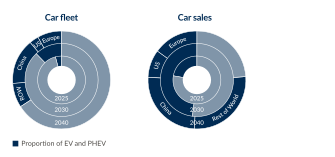
By 2040, the total global car fleet is expected to increase by around 500 million units to nearly 2 billion. Even with continued growth in sales, EVs and PHEVs are still likely to represent around a third of the total fleet. This underlines the structural challenge of reducing the share of internal combustion engine (ICE) vehicles in the global fleet within typical vehicle turnover cycles.
The global car fleet is expected to grow, supporting passenger road fuel demand over the forecast period.
Former Soviet Union (FSU)
With a global fleet of around 1.3 billion ICE cars by 2040, liquid fuels are likely to remain material to road transport demand. While a fleet of around 690 million EVs and PHEVs on the road by 2040 could deliver a meaningful reduction in gasoline demand, the scale of displacement will depend on the real-world usage of PHEVs (i.e. the proportion of kilometres driven on battery versus gasoline), as well as regional differences in driving patterns and average vehicle efficiency.
Battery-swapping is a charging innovation particularly for two- and three-wheeled vehicles. In emerging economies where this segment predominates, it could accelerate the electrification of road transport still further. It offers a lower lifetime cost per vehicle, a charging solution where infrastructure or home charging is lacking, and improved time efficiency. Widespread access could also lower the day-to-day running costs of these vehicles against petroleum alternatives, further spurring adoption.
EVs and PHEVs are likely to represent around a third of the total fleet in 2040
Automakers are evaluating range-extender electric vehicles (REEVs) as a response to persistent range anxiety.
REEVs use a small petrol engine solely as a generator to recharge the traction battery, combining electric drive with the security of on-board fuel backup.
This configuration is particularly relevant for larger, high-load vehicles and for rural users where charging coverage remains limited. Depending on the model, combined driving range between refuelling can exceed 1,000km (manufacturer-claimed).
The medium-term relevance of REEVs is, however, uncertain. After rapid growth in China – exceeding 10% of new domestic car sales in 2024 – adoption has begun to plateau as the relative advantages over EV charge distance narrows. Recent developments include longer-range next-generation batteries (circa 650km per charge), rapid expansion of public charging infrastructure, and higher charging power that reduces total charging time. Given China’s lead in EV adoption, similar dynamics may emerge in Europe and the US.
In Europe and the US, many new EVs already deliver approximately 450km of range, with an increasing number approaching or exceeding 600km. Continued improvements, including solid-state battery development, are expected to further increase range and materially reduce charging times, potentially limiting the need for petrol-based backup for most use cases over time.
As such, the withdrawal of incentives and the softening or deferral of regulatory targets in some regions has slowed near-term growth. Nevertheless, the global direction of travel continues, underpinned by two factors:
1. Improving cost and capability at the mass-market level
EVs are increasingly able to deliver comparable functionality at close to the cost of an ICE vehicle, a trend expected to accelerate as technology improves and manufacturing efficiencies scale. This is coupled with the roll out of increasingly powerful chargers, significantly reducing charging times.
2. Rising exports from China into emerging markets
With China’s domestic market at around 50% EV/PHEV sales, Chinese Original Equipment Manufacturers (OEMs) are increasingly exporting surplus supply into price-sensitive markets, supporting faster uptake than previously anticipated in emerging markets. This is particularly the case in Central and South America and Asia (excluding China) where the combined EV passenger car fleet is expected to increase by nearly 100 million units by 2040.
Chinese OEM exports are supporting faster uptake than previously anticipated in emerging markets
Former Soviet Union (FSU)
Road Transport - Gasoline and diesel displacement
Rising new energy vehicle (NEV) penetration progressively reduces the addressable market for gasoline and, over time, diesel. The effect is cumulative and shifts the demand growth trajectory lower, because even as overall mobility demand continues to rise, a growing share of kilometres travelled is served by alternative transport fuels.
As NEVs increase across the transport mix, both gasoline and diesel are displaced
NEV use in barrel of oil equivalent
Road transport - Diesel key drivers
The initial pace of decline is expected to be slow compared to gasoline, but begins to gather pace from 2035 onwards, with global consumption falling by 0.9 million bpd to 19.6 million bpd by 2040.
While the adoption of electric light commercial vehicles (LCVs) has underperformed versus our previous assumptions, this has been offset by an increasingly optimistic outlook for eHCVs. China is providing proof of concept initially with a reliance on battery swapping to support scale. The likelihood is that the technology is exported to other markets.
This is significant as the HCV sector currently accounts for 60% of road diesel consumption, with the fleet expected to increase by over 12% to 65 million units by 2040.
This could also apply to other segments like long range coach fleets.
While the bus segment is a small sector for global diesel demand, there will likely be further success in the electrification of urban bus systems – expedited due to the centralised nature of government decision-making. Given that the cost of electric buses compared to ICE equivalents is often lower, this is likely to occur even in locations where low-carbon transport solutions have not been prioritised.
As the use of other fuels by commercial vehicles increases, diesel is expected to stagnate before declines begin to gather pace from 2035
Shaded section indicates timing of COVID-19 pandemic
Road transport - Case study
A Vitol-owned company, VGMobility provides e-mobility solutions across the Americas, including electric fleet provision, charging infrastructure, depot design and construction, and asset management.
It is optimally placed to support municipal transport providers with their decarbonisation goals and enable the wholesale shift to electromobility. Currently VGMobility’s portfolio includes projects across Latin America with over 2,700 buses, transporting more than 30 million passengers, and saving over 1,835 tons of CO2 each month.

The long term oil demand outlook report includes Vitol’s views on and forecasts of both historical levels and projections of future energy demand, supply, and trends based upon internal data and analyses as well as publicly available information from a variety of external sources. The report contains forward looking statements, including projections, targets, expectations, estimates and assumptions of future behaviours. Actual future conditions and results (including energy demand, energy supply, the growth of energy demand and supply, the impact of new technologies, the relative mix of energy across sources, economic sectors and geographic regions, imports and exports of energy, and emissions and plans to reduce emissions) could differ materially due to changes in economic conditions, the ability to scale new technologies on a cost-effective basis, unexpected technological developments, the development of new supply sources, changes in law or government policy, political events, demographic changes, trade patterns, the development and enforcement of global, regional or national mandates, changes in consumer preferences, and various other factors. The report was published in February 2026. Vitol assumes no duty to update these statements or materials as of any future date, and neither future distribution of this material nor the continued availability of this material in archive form on our website should be deemed to constitute an update or re-affirmation of this material as of any future date. This material is not to be used or reproduced without the permission of Vitol. All rights reserved.